
Guide
EGR Valve Fault Symptoms, and What You Can Do About Them
By Wojtek Kujawski, Voytech Tuning · · updated
The short answer
A failing EGR valve usually shows as an engine management light with a code such as P0401, rough idling, hesitation under acceleration, higher fuel use and more smoke. The usual cause is carbon jamming the valve open or shut. On a road car the fix is a clean or a new valve at a garage, after a proper diagnosis.
EGR delete remaps from £195, for off-road use
Mobile, at your home or work across Merseyside and Greater Manchester.
What The EGR Valve Does
EGR stands for exhaust gas recirculation. The valve feeds a measured amount of exhaust gas back into the engine's intake, which lowers the combustion temperature and cuts the nitrogen oxides the engine produces. The engine computer decides how far to open it, moment by moment.
It works in the dirtiest gas the engine makes. Exhaust carries soot, and the RAC's guide describes soot and residue building up on the valve until it can no longer control the flow. A valve that should snap open and shut starts to drag, then sticks.
EGR Valve Fault Symptoms
What you notice depends on whether the valve has stuck open, stuck shut or is slow to move. These are the signs drivers report.
- The engine management light, with an EGR fault code stored.
- Rough or lumpy idling, and sometimes stalling as you roll to a stop. That is the classic sign of a valve stuck open.
- Hesitation or flat spots when you accelerate, and less power overall.
- Higher fuel use.
- More smoke from the exhaust. On a diesel, a valve stuck open makes extra soot.
- A knocking noise under load, which the RAC lists among the signs.
- A DPF warning not long after, because that extra soot ends up in the particulate filter.
EGR Fault Codes: P0401 and The Rest
None of those symptoms belongs to the EGR valve alone. Stoneacre's guide points out that a failing turbo, a blocked DPF or an airflow sensor fault can feel the same, so the stored code is the next thing to look at.
These are the generic EGR codes that every make shares. Manufacturers add their own, and a code names the complaint, not the failed part.
| Code | What It Means | What It Usually Points To |
|---|---|---|
| P0400 | EGR flow malfunction | Flow is not what the computer asked for: a sticking valve or blocked passages |
| P0401 | Insufficient EGR flow | A valve stuck shut, or the valve and its passages choked with carbon |
| P0402 | Excessive EGR flow | A valve stuck open or not sealing |
| P0403 | EGR control circuit fault | Wiring, the connector or the valve's solenoid |
| P0404 | EGR range or performance | The valve is not where the computer told it to be: carbon, or a failing valve |
Why EGR Valves Fail
Carbon is the main cause. Soot and residue coat the valve and the passages around it until it cannot move freely. Short, cold trips are widely blamed for speeding that up, and they are the same journeys the RAC names as the main cause of a blocked DPF.
The second cause is electrical. Modern valves are moved by a solenoid or motor and report their position back to the computer. When the actuator or its sensor fails, the valve can be spotless and still set a code, and cleaning will not bring it back.
Clean, Replace, Blank Or Delete: The Four Options
What you can do depends on what has failed and on how the vehicle is used. For a car or van that stays on the road, the choice is between the first two.
- Clean. Where carbon is the only fault, the RAC says a mechanic may be able to clean the valve and its passages. It costs the least, and the engine carries on making soot, so it is a reset and not a cure.
- Replace. Where the actuator, the sensor or another electrical part has failed, the valve usually needs replacing.
- Blank. A metal plate bolted across the EGR pipe stops the flow. A modern engine computer usually notices the missing flow and logs a fault, and on a road vehicle a blank is in the same legal position as a delete.
- Delete by remap. The engine software is changed so it stops using the valve and no longer logs EGR faults. This is for off-road, competition, agricultural and export vehicles.
Why An EGR Fault and A Blocked DPF Turn Up Together
The two systems share the same soot. A valve stuck open upsets combustion and makes more of it, and every bit lands in the particulate filter. The filter fills faster than it can regenerate, the DPF light joins the engine light, and cleaning the filter without dealing with the valve only resets the clock.
That link is the reason our DPF visits start with the fault codes and the live readings. A stored EGR code shows up before any cleaning starts. When we find one we tell you, because a clean will not hold while the valve keeps feeding the filter.
What We Do About EGR Faults, and What We Do Not
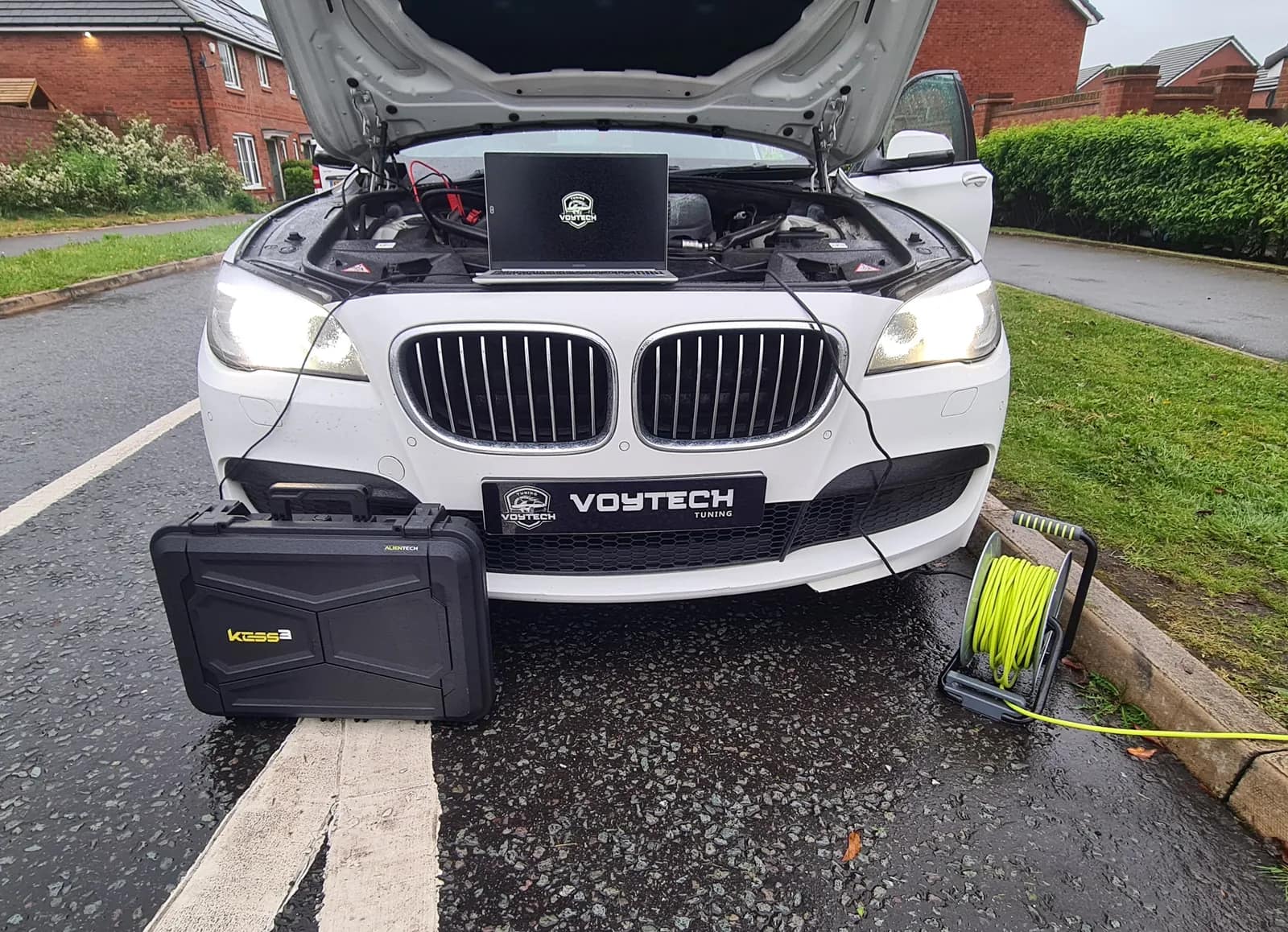
We do not diagnose, clean or replace EGR valves, and we would rather say so here than on your drive. Our EGR work is the delete by remap, done at the vehicle for off-road, competition, agricultural and export use. The detail is on our EGR delete page.
For a road car showing both an EGR code and a DPF warning, we can clean the filter and show you the readings before and after, and you take the EGR finding to your garage. Send the registration and the code through the contact page and we will tell you which of those fits your vehicle.
Sources
- RAC, EGR valve replacement
- Stoneacre, EGR valve explained
- OBD-Codes.com, P0400 Exhaust Gas Recirculation Flow Malfunction
- OBD-Codes.com, P0401 Insufficient EGR Flow
- OBD-Codes.com, P0402 Exhaust Gas Recirculation Flow Excessive Detected
- OBD-Codes.com, P0403 Exhaust Gas Recirculation Circuit Malfunction
- OBD-Codes.com, P0404 Exhaust Gas Recirculation Circuit Range/Performance
- RAC, Diesel particulate filters
- Road Vehicles (Construction and Use) Regulations 1986, regulation 61A(3)
- GOV.UK MOT inspection manual, section 8.2.2
- Department for Transport consultation, Regulating environmental impact of in-use emissions of road vehicles, 6 July to 6 September 2026