
Guide
How To Tell If A Car Has Been Remapped
By Wojtek Kujawski, Voytech Tuning ·
The short answer
The only reliable way to tell if a car has been remapped is to read the engine computer (ECU) and compare its software with the manufacturer's. Stickers, paperwork, smoke or strong performance are clues, not proof. A scan tool can show the calibration ID and verification number, and a full ECU read confirms whether the map has been changed.
Back to stock from £200
Mobile, at your home or work across Merseyside and Greater Manchester.
Why It Matters To Know
A remap is a modification, and your insurer needs to know about it even if a previous owner did it. The Financial Ombudsman Service has said plainly that inheriting a modification with a used car does not protect you if a claim is later refused. A remap can also matter to a dealer handling warranty work, and to anyone you sell the car to.
Remaps do not show on the outside of a car and are not part of a standard vehicle history check, which covers finance, theft and write-off records. So the question usually comes up after a purchase, when the car feels quicker than it should, or when an insurer or dealer asks.
Signs You Can Check Without Tools
None of these prove anything alone. Two or three together are a good reason to have the ECU read.
- A tuner's sticker on the engine cover, the ECU, a door shut or the rear window. They are often peeled off before a sale.
- Invoices or messages from a tuning company in the service folder, or a tuner's name on a receipt.
- Performance that feels well above the published figures for that engine: stronger pull in the mid range, earlier boost, a car that feels a size bigger.
- Black smoke under hard acceleration on a diesel, which can mean more fuel is being injected than the standard map allows.
- An extra box plugged into the engine wiring. That is a tuning box, not a remap, but it tells you someone has been chasing power.
- On a diesel, a missing warning light or no DPF regenerations at all, which can point to an emissions delete rather than a plain remap.
How An ECU Read Shows A Remap
The engine computer stores its software as a calibration. Under the on-board diagnostics standard, a scan tool can ask the ECU for its calibration ID (CAL ID, the software version) and a calibration verification number (CVN), which is a checksum worked out from the software itself. Change the map and the CVN usually changes too, so it no longer matches the figure the manufacturer holds for that software version. Main dealer equipment makes this comparison and can flag the software as not genuine.
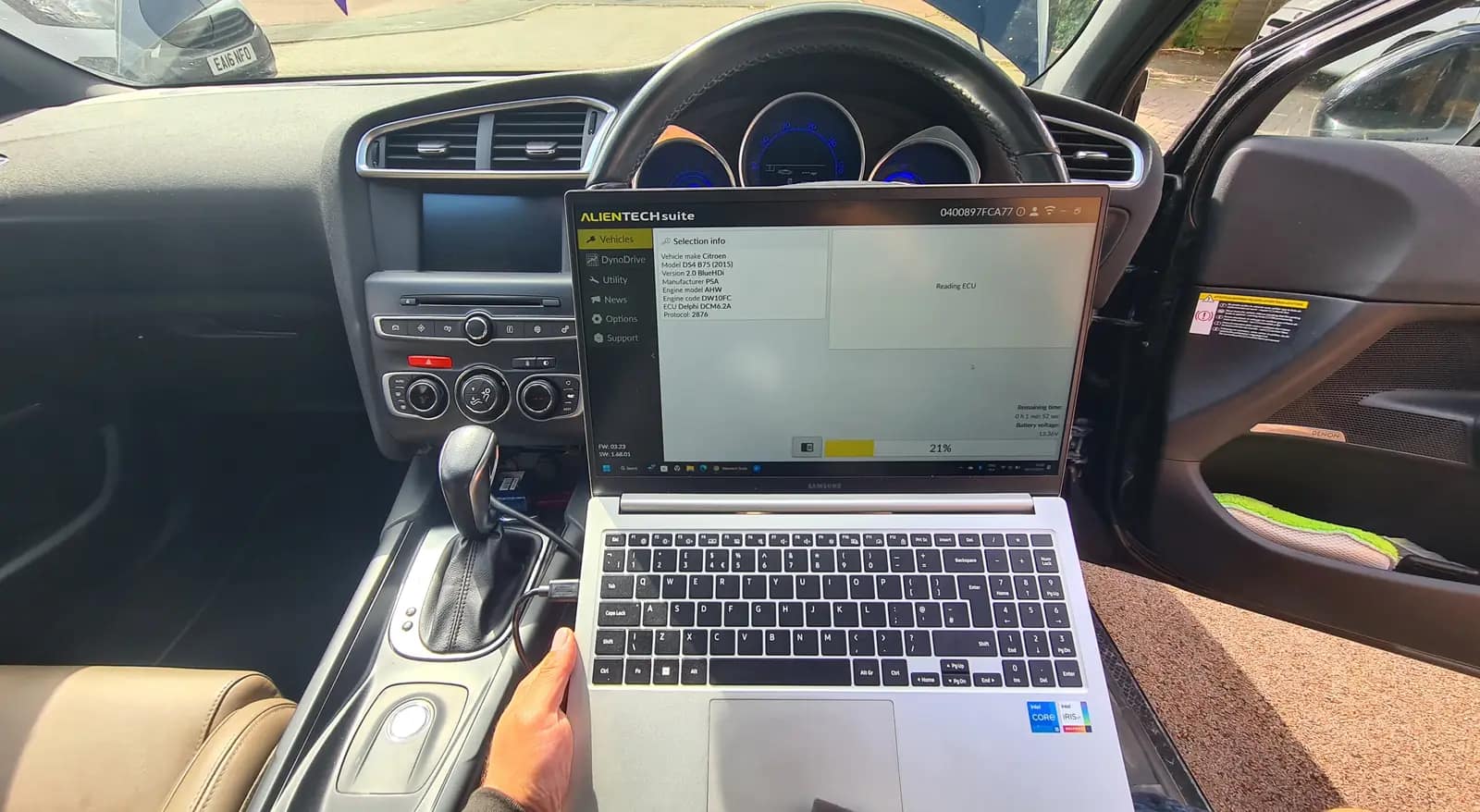
The deeper check is a full read of the ECU with tuning equipment. The file taken off the car is compared with the standard file for the same software number. Changed fuel, boost, torque limiter or timing tables show up clearly. On some ECUs the full read can be done through the diagnostic socket; others have to be read on the bench or through the boot mode of the processor.
| Check | What It Shows | How Far To Trust It |
|---|---|---|
| Visual signs and paperwork | A tuner's name, a sticker, a tuning box | A clue only |
| Driving and smoke | Power above standard, extra fuelling | A clue only |
| Generic scan tool (CAL ID and CVN) | Whether the software ID and checksum match the manufacturer's | Good, but some tools correct the checksum |
| Dealer diagnostic system | Whether the software is recognised as genuine | Good |
| Full ECU read and file comparison | Exactly which maps have been changed | The most reliable |
What An ECU Check Cannot Tell You
A matching CVN is strong evidence the car is standard, but it is not a guarantee, because some tuning tools correct the checksum after writing a new map. A car that was remapped and later put back to stock may show standard software today, and the read cannot tell you what the car was running a year ago. Some ECUs also keep a count of programming sessions, which hints at past work without showing what it was.
What To Do If The Car Has Been Remapped
You have two clean options. Keep the remap and declare it to your insurer, with whatever details you can get about the power gain and who did it. Or have the car returned to its standard software and tell your insurer the modification has been removed.
Returning a car to stock needs the original software for that ECU, or a standard file that matches the exact software version. If a previous owner's tuner kept the original, ask for it. Our back to stock service puts a remapped car back on standard software; it starts from £200, and the exact price depends on the vehicle and on what file is available. If you would rather keep the extra power, our custom Stage 1 remap starts from £200, and a new map from us is written for the car in front of us.
Sources
- OBD Mode 09 vehicle information
- CVN mismatch flagged by manufacturer diagnostic equipment, and correction of CVN by some tools
- California Bureau of Automotive Repair, OBD system vehicle tampering prevention (software checks for tampering)
- Financial Ombudsman Service, Car modifications can wreck your insurance, 30 September 2024 (previous owners' modifications)
- Adrian Flux, Can insurance tell if a car is remapped (stickers often removed; buyer's responsibility to find out)
- GOV.UK MOT inspection manual section 8 (emission control equipment, MIL, smoke opacity)