
Guide
P2463 and P2002: What These DPF Fault Codes Mean and What Fixes Them
By Wojtek Kujawski, Voytech Tuning ·
The short answer
P2463 means the engine computer has measured too much soot in the diesel particulate filter. P2002 means the pressure readings across the filter do not match a working filter. Neither code proves the filter is finished. A failed sensor, a split hose or regenerations that keep getting cut short set the same codes, so the live readings decide the fix.
Mobile DPF cleaning from £225, diagnostics included
Mobile, at your home or work across Merseyside and Greater Manchester.
What A DPF Fault Code Can and Cannot Tell You
A fault code records what the engine computer noticed, not which part has failed. The computer never sees inside the filter. It works out how full the DPF is from a differential pressure sensor, which compares the pressure before and after the filter, and it controls the burn-off with exhaust temperature sensors. If one of those is wrong, the code is wrong with it.
That is why we read the live figures before we believe any code. On a Mercedes Sprinter van in St Helens the soot load was showing 120% and the van was in limp mode. The filter was full, but the cause was two of the three exhaust temperature sensors, which had stopped working, so the van could not regenerate.
Some readers print extra characters after the code, such as P2002:00 on a Ford or P246300 on a Volkswagen group car. Those describe the type of fault and its status. The first five characters are the code to look up.
The DPF Fault Codes You Are Most Likely To See
These are the generic codes, the ones every make shares. Manufacturers add their own on top, so treat the table as a guide to what the computer is complaining about, not as a diagnosis.
| Code | What The Computer Is Saying | What It Often Turns Out To Be |
|---|---|---|
| P2463 | DPF restriction: soot accumulation | Regenerations not finishing, or a pressure sensor or hose reading high |
| P2002 | DPF efficiency below threshold | A sensor, hose or exhaust leak fault, or a filter that is cracked or has been hollowed out |
| P242F | DPF restriction: ash accumulation | A high-mileage filter filling with ash, which no regeneration can burn |
| P244A | DPF differential pressure too low | A split or disconnected sensor hose, an exhaust leak or a damaged filter core |
| P2452 to P2455 | DPF pressure sensor circuit faults | The sensor itself, its wiring or its two small hoses |
| P2458 and P2459 | Regeneration taking too long, or happening too often | Regenerations that cannot complete, or a filter loading faster than it should |
P2463: Why The Soot Is Not Burning Off
P2463 is usually an honest code. The pressure across the filter has climbed past the limit the computer allows, because soot has built up and has not been burned off. That is the job of a regeneration, which needs a hot exhaust and enough time to finish. The RAC names short, low-speed journeys as the main reason it does not happen.
The other reason is a car that refuses to regenerate. Some makers will not start a burn on a nearly empty tank, and Volkswagen tells drivers to refuel first. A failed temperature sensor, a pressure sensor fault or an EGR valve stuck open, which makes extra soot, all leave the filter filling with no way to empty.
If the DPF light is amber and the car drives normally, the regeneration drive in your handbook is the right first step. In limp mode, or with a flashing light or the engine management light on as well, more driving will not clear it.
P2002: When The Readings Do Not Add Up
P2002 is a different complaint. The computer expects a certain pressure drop across a filter that is doing its job. When the figures do not fit over more than one drive, it logs the filter as below efficiency. A filter that has cracked, melted or been hollowed out lets gas straight through and sets this code.
Before blaming the filter, check what feeds the reading. The pressure sensor is joined to the exhaust by two small hoses that split, melt or block, and an exhaust leak ahead of the filter changes the reading too.
A 2021 Ford Kuga we saw in St Helens shows how wrong the obvious guess can be. With 30,000 miles on it we expected a pressure sensor or a temperature sensor. There was no pressure at all at either sensor pipe. AdBlue had crystallised around the injector and blocked them, so the computer had no true reading of the filter.
What Clearing The Code Does, and What It Leaves Behind
A code reader will clear P2463 or P2002 in seconds. It clears the record, not the soot and not the fault. If the filter is still loaded or the sensor is still wrong, the code is back within a few drives, sometimes with limp mode this time.
Clearing it before an MOT does not help either. On diesels first used from 1 July 2008 an engine management light showing a fault is a major defect, and so is visible smoke from a car fitted with a DPF.
What Fixes Each Code
The fix follows the cause, which is why two cars with the same code can need different work.
- Soot from short trips and no other fault: a completed regeneration, or a DPF clean if the car can no longer manage one itself.
- A dead temperature or pressure sensor, a split hose or an exhaust leak: that repair comes first. Clean a filter the car still cannot regenerate and it fills again.
- An EGR or AdBlue fault feeding the problem: that system needs dealing with as well, for the same reason.
- Ash on a high-mileage car (P242F): the AA says ash only comes out with the filter off the car at a specialist cleaner. The alternative is a new filter.
- A cracked, melted or hollowed-out filter: replacement. No clean repairs a broken core.
How We Deal With DPF Codes At Your Door
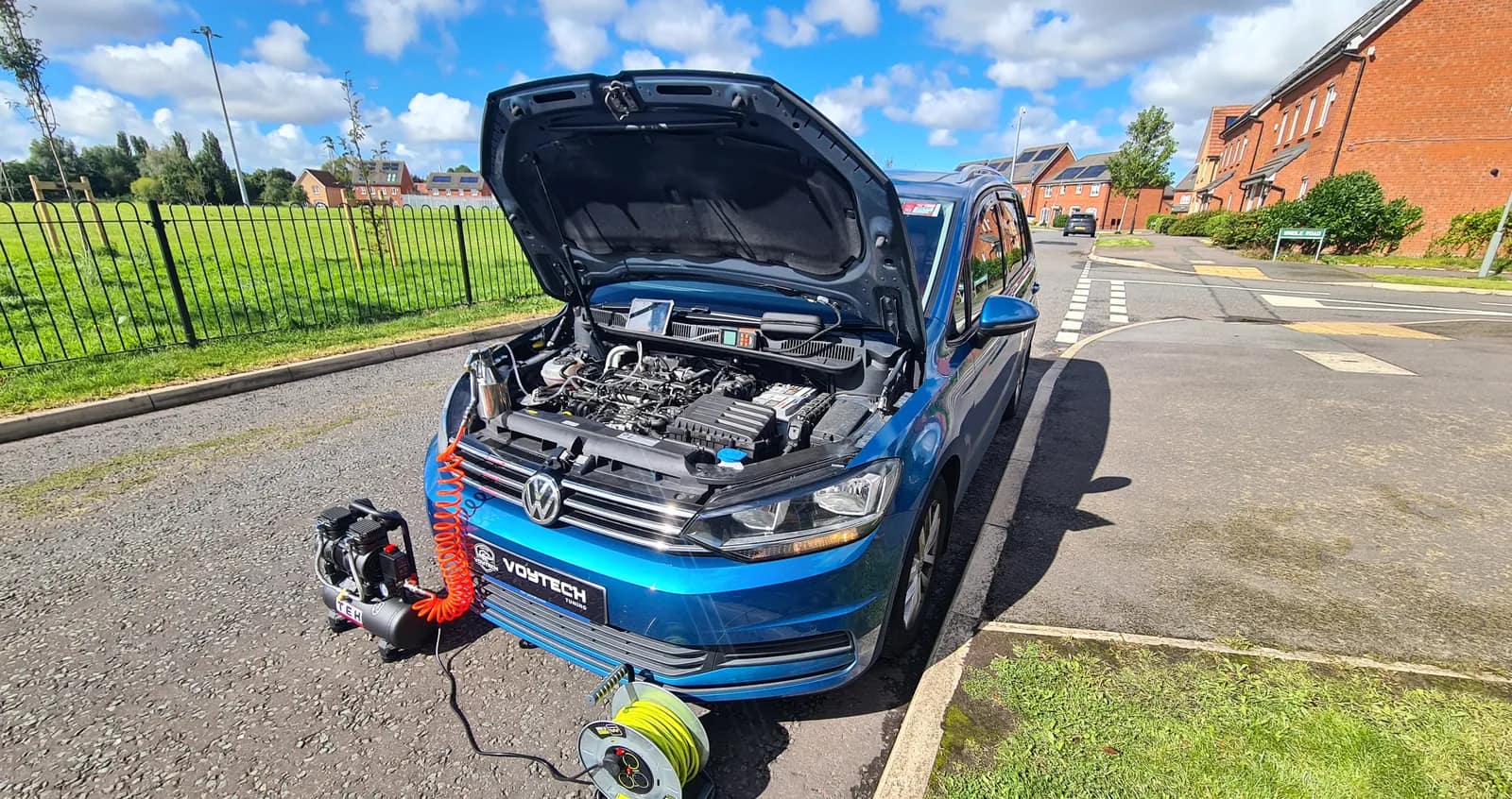
Our mobile DPF service starts with the codes and the live readings, not with the cleaning kit. We scan the car, check the filter's pressure and soot figures and the sensors that control regeneration, and only then decide whether a clean is the right job. If it is, a high-pressure chemical clean follows, and the figures are read again so you can see the difference.
If the readings point to a fault a clean will not fix, we tell you what it is. We do not replace sensors or filters, and we do not repair EGR or AdBlue systems. The work is done where the car is parked across Liverpool, Manchester and the North West, and the average visit is 45 to 60 minutes. Send us the code and the registration through the contact page and we will tell you what we would check first.
Sources
- OBD-Codes.com, P2463 Diesel Particulate Filter Restriction, Soot Accumulation
- OBD-Codes.com, P2002 Diesel Particulate Filter Efficiency Below Threshold Bank 1
- OBD-Codes.com, P242F Diesel Particulate Filter Restriction, Ash Accumulation
- OBD-Codes.com, P2400 to P2499 code list
- Bosch Mobility, Differential pressure sensor
- RAC, Diesel particulate filters
- The AA, Diesel particulate filters
- Volkswagen UK, Diesel particulate filter warning light
- DieselNet, Ash accumulation in diesel particulate filters
- GOV.UK MOT inspection manual, section 8.2.2